
Returning to the normal flow of the blog after the last post’s digression through the Northwest Passage, I’ll pick up the thread as we returned home from the cross-country road trip, whose second half turned out every bit as awesome as the first. We picked up seven new shops as dealers, with several others eager to make orders in the spring, when mountain shops shift from winter fun to summer cragging mode. Glad to be back, we were nonetheless a little sorry it was over, and may just go on another tour again sometime. If only the Midwest weren’t so wide….
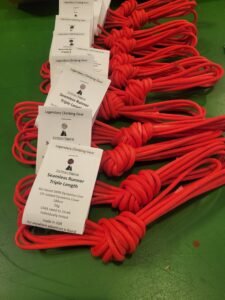
We had to hit the ground running, as there were backorders to fill, as well as a small mountain of sailboat rope that had piled up awaiting our return. The children had thrived in our absence, their worst setback a flat tire when miles and miles from home, but were glad to give most of the cooking over to us again. Between cutting, splicing, and dyeing mountains of slings, we designed packaging, put together a PDF product catalog to email out, and watched winter get closer every day.
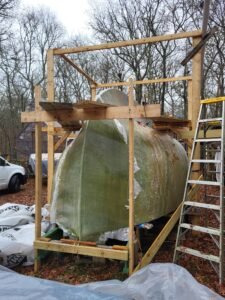
I had hoped to get a lot more fiberglass onto the boat’s hull before it got too cold, but in the end we only had two warm-enough days, which sufficed to get a good layup on the keel shoe and some work on the bow section before we put the tarp over her for good and all. Time to do inside things until spring.
My workshop is divided into two unequal spaces. The smaller one, where I do all my rigging, (the “clean shop”) is pretty well insulated and has a woodstove, so it’s an all-season room. The “dirty shop” is much harder to heat, and is only really tenable when the outside temps are above freezing. Anticipating some glasswork in there, I set up a Dickinson diesel heater/stove that I’m keeping for Arctic sailing on Ganymede when time and circumstance allow. It doesn’t do much beyond taking the edge off, but it allows us to work in there on rare warm days, where we’ve begun work on the rudder.
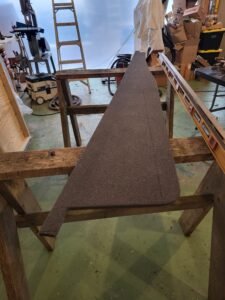
It’s pretty easy to design a barn-door stern-hung rudder for a full-keel boat: the only question is “how big?” With the help of my old friend Skene, we came up with dimensions that pleased the eye, and cut a blank out of a sheet of high-density core material called “Penske Board.” Standing against the wall for a few months since we’d cut keel-shoe core out of it, the board had a slight bend that didn’t want to flatten out until we’d glassed over each edge of it with the opposite edge clamped onto straightedges.
Once the rudder was shape-stabilized and laser-straight (we checked it with the laser), we did the heavy layup in one long session, wrapped it in peel-ply to keep the glass from sagging off the underside, and then wrapped plastic packing film over everything to make sure the glass stayed tight, especially around the edges, where we want no bubbles to disturb the attachment to the sternpost.
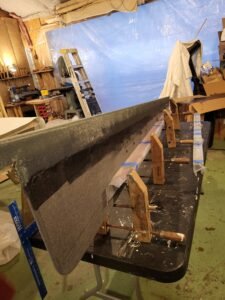
There’s something diabolically difficult about getting peel-ply off when it’s been firmly pressed on: it’s like it wants to be part of the laminate. Sometimes it takes plyers to grasp a flap firmly enough to yank it, and always I’m amazed the material doesn’t just tear and leave itself behind. But the rudder looked pretty good once we’d got the peel-ply off, and after that there were only the ends to fix where we’d left tabs sticking out so it could be hung to laminate on both sides at once.
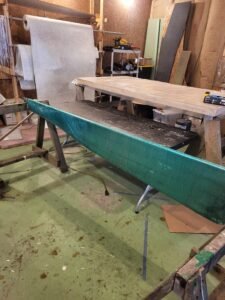
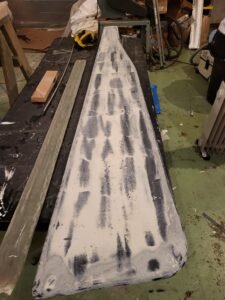
It’s got one good, tight skim of fairing compound on it now. The next step is to coat it with Duratek primer (so the thickened resin will fully cure for sanding), and fair it to symmetry.
In the meantime, after mapping out a laminate schedule for the hull and measuring all the pieces we need, we’ve begun slowly cutting all the fiberglass cloth, stacking it in carefully labeled layers. Most of the layup will be with 24-oz woven roving, which is the most economical for this sort of job. We’ve already gone through two rolls of it, and begun a third. Each roll weighs 250 pounds, and takes about the same weight of resin to soak it, so we can roughly calculate the weight of the hull once we’ve seen how much glass was used. Having it all pre-cut before spring will allow us to maximize the brief time window when temperatures are ideal for laminating, and before we go into full-time summer employment mode, and there’s no time to do anything.

Till then, between digging ourselves out of the heaps of snow that this winter has brought, we’ll chip away at the rudder project in the freezing shop, waiting for warmer weather so we can burst into action.