There are those who track personal records—Six weeks since my last avocado schmear! Or caramel latte, or chocolate muffin—just to congratulate and encourage themselves in doing good. Sadly, all my personal records go the other direction, and I can more easily count the days since I did something good than abstained from something bad. My newest personal…..worst, I guess, is that this is the longest I’ve gone in more than a decade of blogging without putting up a post. And not because I have nothing to blog about, which never stopped me before. Rather, I’ve been doing tons of interesting stuff, and it shoved the poor neglected blog into the shadows.
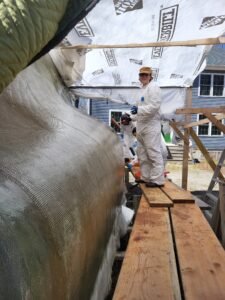
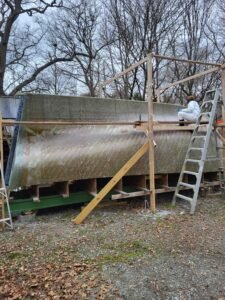
Last blog post, a whole year ago (blush), had the tiny cutter hull we’re building with one layer of glass on it, waiting upside down for spring so we could begin fiberglass work again. Having cut all the cloth we needed over the winter, we didn’t need much prep, but spring is always a busy time. What with one thing and another, we didn’t manage to coordinate the major hull lamination until the sun was uncomfortably warm. It ended up a bit of a race during brief shade times, and took some extra days to get the full laminate schedule on the boat.
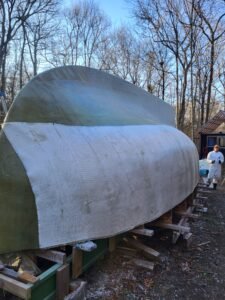
The summer was mostly spent getting the hull faired, from the keel down to the waterline, since we judged it easier to sand with the hull upside down than ourselves upside down underneath it later. The part between the waterline and the gunwale we didn’t fair, since much glasswork remained to be done there, and it would have been a waste.
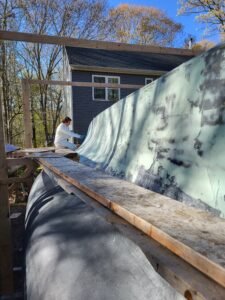
Our care to stagger the seams of successive layers of cloth, without overlapping them, paid off in the fairing process, and nowhere did the hull require as much as a quarter-inch of compound. Still, we used about thirteen gallons of vinylester fairing compound to achieve a fairly even and smooth bottom. I always wonder how much of that gets sanded off between smears, but can’t really grudge it since the method, if followed conscientiously, always works.
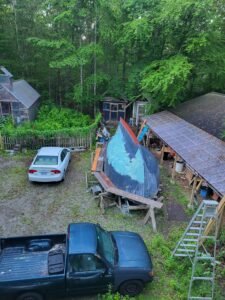
By late summer, the hull was faired and primed with black Duratek primer. The last step before flipping the hull was to paint the bottom of the keel and a few inches around the edges with antifouling, since once the hull was on blocks, access there would be difficult.
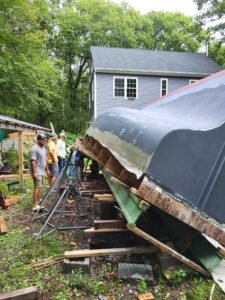
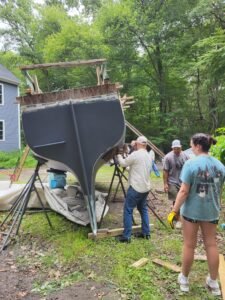
Unable to secure a friend’s crane (the only sort we could have afforded) to flip the hull with, we enlisted instead a gang of willing friends and co-workers. After putting all the padding and soft stuff we could gather on the far side of the hull, we stuck bottle jacks, farm jacks, and jackstands under the near side and slowly levered it up. It took a good bit of re-adjusting jacks, stacking safety blocks, and nervous scurrying, but eventually the hull reached a tipping point, we all heaved in unison, and over it went onto the nest of Styrofoam blocks and blankets.
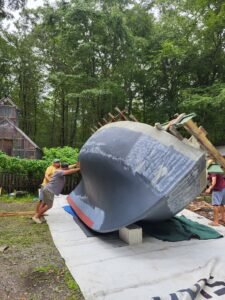
Using a jeep and a rope as a sort of tug to rotate the hull into position, we then got blocks under the keel and slowly, inch by inch, jacked it upright.
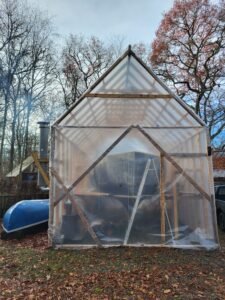
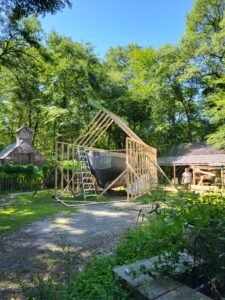
An old sail did fine to keep the rain out while we built a very basic shed around the hull. It’s not one of those fancy, curvy Stimson sheds all the cool boatbuilders have—it’s just a stick-framed hut with a ridgepole made from one of the strongbacks the hull was built on, and a fair bit of the lumber from the boat frame and scaffolding holding it up. Still, it’s dry, has plenty of headroom, and it’s dead easy to attach scaffolding, shelving, and any other accessory we need.
As autumn temperatures drop, we’ve put ends on the shed and installed a wood stove to help along the greenhouse effect of the clear plastic covering. That’s given us an easy ten degrees or more of extra warmth inside, and allowed some big laminations without the dreaded resin runout you get when it’s too cold. With any luck, the entire inside of the hull will have its skin of fiberglass on before it’s too difficult to heat, and we can spend the coldest, shortest days doing smaller local laminations, building deck sections inside the shop, and melting three thousand pounds of lead into ingots. The long winter evenings, I tell myself, will be ideal for keeping up with the blog. Maybe that will keep me from going for another personal worst.